The right PCB surface finish depends on three things: how small your component pitch is, how long boards will sit before assembly, and your budget. For most through-hole and general SMT boards, lead-free HASL is the cheapest reliable option. For fine-pitch parts and BGAs, ENIG is the standard choice. OSP works well for high-volume boards that get assembled quickly.
Below is a breakdown of each finish and a simple way to pick one for your next order.
What Does a PCB Surface Finish Actually Do?
Bare copper oxidizes fast. Once it oxidizes, solder won’t wet the pads properly, and you end up with weak joints or open circuits.
A surface finish is a thin coating applied over exposed copper pads. It protects the copper until assembly and gives solder a clean surface to bond to. The finish you choose affects pad flatness, shelf life, rework options, and cost.
HASL and Lead-Free HASL
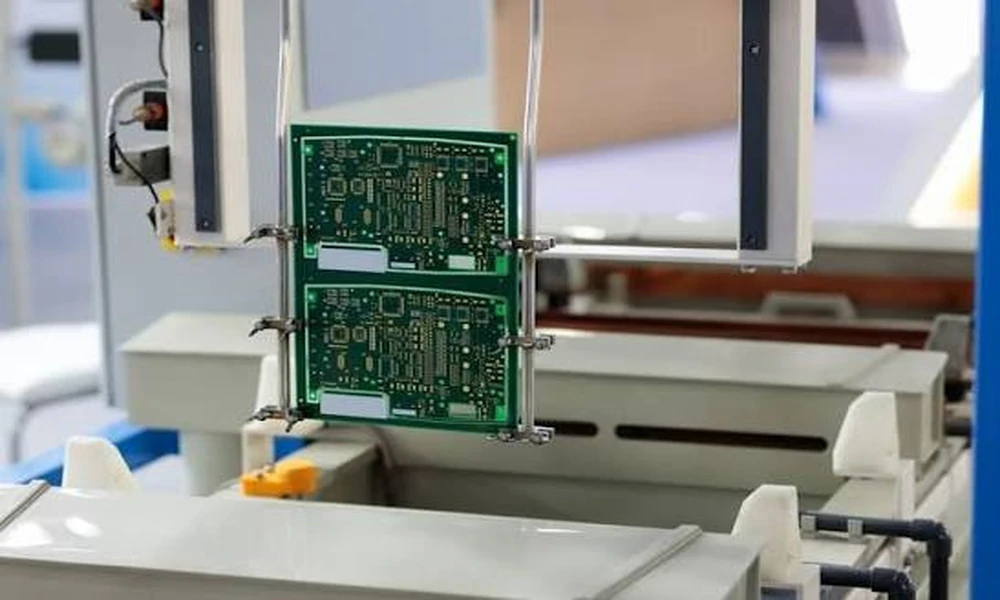
Hot Air Solder Leveling (HASL) dips the board in molten solder, then blows off the excess with hot air knives. It has been the industry workhorse for decades.
HASL coatings typically range from 1 to 40 µm thick, with a shelf life of about 12 months. That wide thickness range is the main problem. Pads end up slightly domed instead of flat.
On the plus side, HASL is the lowest cost of the common finishes, solders extremely well, is easy to rework, and lasts a long time in storage. The downsides are uneven pads, a poor fit for fine-pitch parts, and the fact that the leaded version isn’t RoHS compliant.
Domed pads make solder bridging hard to control on tight layouts, which is why HASL is a poor choice for fine-pitch SMDs and BGAs. A practical rule many fabricators use is to avoid HASL below 0.5 mm pitch.
Lead-free HASL also runs hot. The process exposes boards to around 260 °C, which adds thermal stress during fabrication.
ENIG (Electroless Nickel Immersion Gold)
ENIG deposits a nickel layer over the copper, then a very thin gold layer on top. The nickel is the real barrier and solderable surface. The gold just keeps the nickel from oxidizing.
Typical ENIG thickness is 3 to 6 µm of nickel and 0.05 to 0.125 µm of gold, with a shelf life of around 12 months. The result is a very flat pad, which is why ENIG is the go-to finish for BGAs, QFNs, and dense SMT boards.
ENIG gives you excellent flatness, a long shelf life, good performance through multiple reflow cycles, and RoHS compliance. The trade-offs are cost and process sensitivity. ENIG usually runs about 15 to 20% more than HASL, and it carries a risk of “black pad” if the plating line isn’t well controlled.
What Is Black Pad?
Black pad is nickel corrosion that happens during the gold plating step. Affected pads look dull or dark, and solder won’t wet them properly. The joint may look fine at first, then fail later under stress.
The ENIG standard, IPC-4552, grades this corrosion by severity, and the most severe level is rejectable for Class 3 high-reliability products. If you build automotive, medical, or aerospace hardware, ask your fabricator how they monitor nickel corrosion.
OSP (Organic Solderability Preservative)
OSP is a thin, water-based organic coating that bonds to the copper. There’s no metal layer at all, so the pads stay perfectly flat.
OSP is very low cost, flat enough for fine-pitch parts, lead-free, and simple to apply. Its weak points are a short shelf life, sensitivity to handling, degradation with each reflow cycle, and the fact that it’s hard to inspect visually.
Storage matters a lot with OSP. Expect a shelf life of roughly 6 to 12 months, and only if boards are kept below 25 °C and under 60% humidity. OSP fits best when boards go from the fab to the assembly line quickly.
Immersion Silver and Immersion Tin
These two finishes sit between HASL and ENIG on cost and flatness. Both give flat, lead-free surfaces suitable for fine-pitch work.
Immersion silver solders well and stays flat, but it tarnishes in sulfur-rich air and needs careful packaging. Immersion tin is popular for press-fit connectors and backplanes but is very sensitive to humidity.
Both typically offer a shelf life of around 6 months. Humidity hits immersion tin especially hard. In hot, humid conditions, its usable shelf life can drop to just a couple of weeks.
Quick Comparison of PCB Surface Finishes
Leaded HASL has poor flatness, about 12 months of shelf life, no fine-pitch capability, the lowest cost, and no RoHS compliance.
Lead-free HASL has poor flatness, about 12 months of shelf life, no fine-pitch capability, low cost, and full RoHS compliance.
ENIG has excellent flatness, about 12 months of shelf life, strong fine-pitch and BGA support, medium to high cost, and RoHS compliance.
OSP has excellent flatness, 6 to 12 months of shelf life in controlled storage, good fine-pitch support, low cost, and RoHS compliance.
Immersion silver and immersion tin both offer very good flatness, about 6 months of shelf life, good fine-pitch support, medium cost, and RoHS compliance.
How to Choose the Right Finish
Start with component pitch. If you have BGAs, QFNs, or pitch under 0.5 mm, rule out HASL. ENIG is the safe default.
Next, think about storage. If boards will sit for months before assembly, choose ENIG or HASL and avoid OSP and immersion tin.
For a high-volume consumer product that gets assembled right away, OSP can cut cost without hurting quality.
For a simple through-hole or hobby board, lead-free HASL is cheap, rugged, and easy to hand solder.
For high-reliability Class 3 work, use ENIG with documented IPC-4552 compliance, or ask about ENEPIG, which adds a palladium layer to reduce black pad risk.
Common Mistakes to Avoid
The first mistake is picking the cheapest finish by default. Saving a few cents per board on HASL can cost far more in BGA rework and failed joints.
The second is ignoring storage conditions. OSP and immersion finishes can fail solderability checks if boards sit in a humid warehouse for too long.
The third is leaving the finish off the fab drawing. Always specify the finish, and for ENIG, reference IPC-4552 along with the nickel and gold thickness you expect.
Talk to Your Fabricator Early
Surface finish affects fabrication, assembly, and long-term reliability, so it’s worth discussing with your manufacturer before you finalize the design. An experienced board house like Avanti Circuits can tell you which finishes they run in-house, what lead times look like, and which option suits your stackup and component mix.
Frequently Asked Questions
What is the most common PCB surface finish?
HASL and lead-free HASL are still widely used for general boards because of their low cost. ENIG is the most common choice for modern fine-pitch and BGA designs.
Is ENIG better than HASL?
For flatness and fine-pitch parts, yes. For simple boards on a tight budget, HASL is often the better value.
Which PCB finish has the longest shelf life?
HASL and ENIG both typically last around 12 months. OSP, immersion silver, and immersion tin are usually shorter.
Is OSP good for prototypes?
It can be, as long as you assemble quickly. If prototypes might sit for months between builds, ENIG or HASL is safer.